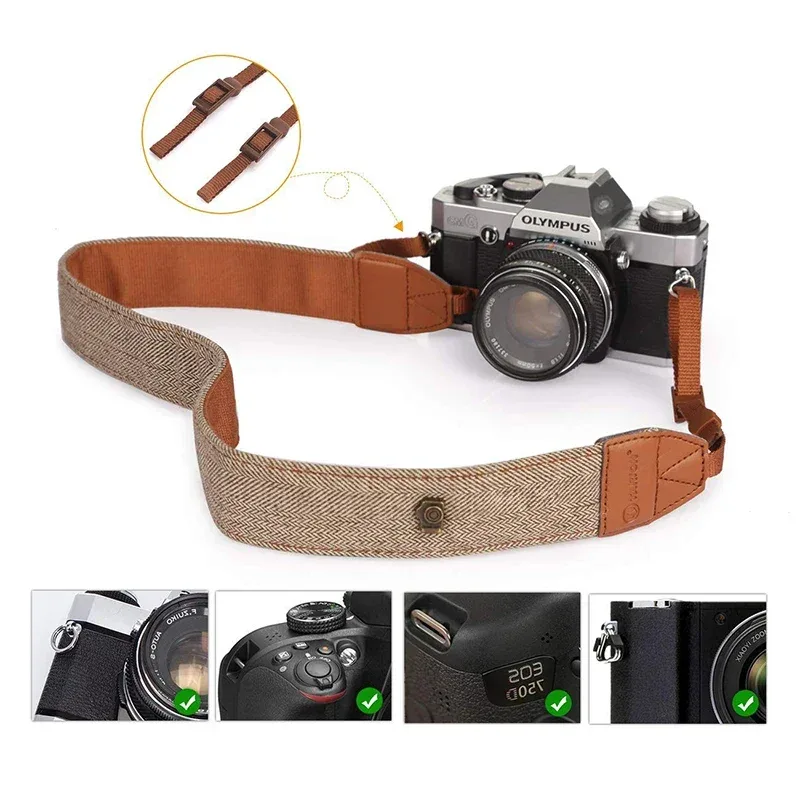
Camera Straps That Come In Seventeen Models, Not Three
One wide cotton and leather band for the classic look, fifteen braided nylon rope cords with metal quick-release rings for everything else. Same strap page, same price, your choice of color.
The cotton band and the braided rope solve the same problem differently
People arrive at this page from two very different directions. Half of them have just bought an old film body, or a mirrorless camera styled like one, and the black nylon strap that came in the box looks wrong against it. They want the tweed. The other half already own three straps and are tired of all of them: too much bulk in the bag, too much fuss taking the strap off before mounting the camera on a tripod, too much black.
We sell one strap in seventeen models rather than seventeen products, because the decision that actually matters is the first one. You are choosing between a flat woven band and a round cord. Everything after that is color, and color is the easy part. Below is the comparison.
| What you are comparing | Cotton and Leather | Braided Rope |
|---|---|---|
| Models available | 2: Charcoal and Camel | 15, solid and two-tone marled |
| Band | Woven cotton tweed in a chevron weave | Round braided nylon cord |
| Hardware | Leather end pieces, leather tabs, press stud | Metal ends and a metal buckle head |
| How it attaches | Thin cord through the eyelet, locked by a flat tab | Split rings plus a quick-release fitting |
| Taking it off the body | Undo the cords and the tabs | Unclip, nothing to unthread |
| Load figure | 6.6 lb (3 kg) on one cord, 22 lb (10 kg) on both leather tabs | — |
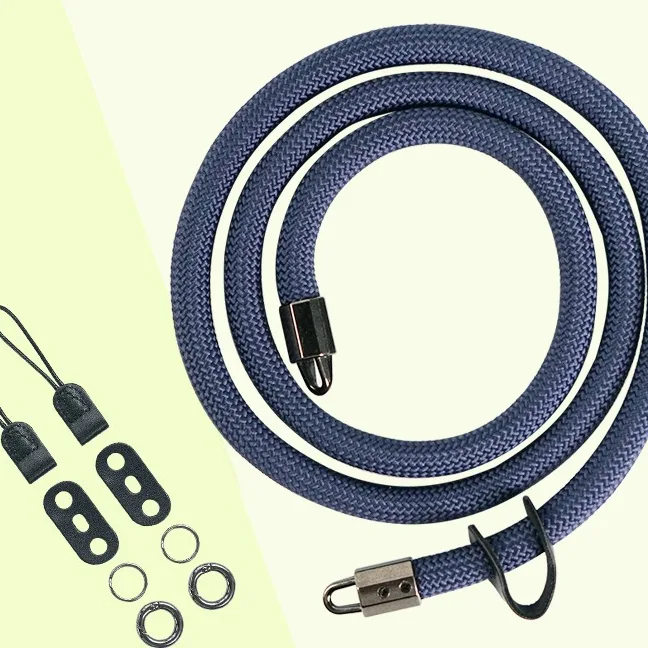
| Mounting kit in the box | Attachment cords and locking tabs | 2 looped cords, 2 flat perforated tabs, 3 split metal rings |
| Reads as | Vintage, analog, warm | Modern, climbing rope, colorful |
| Worn | Neck or one shoulder | Neck or cross-body |
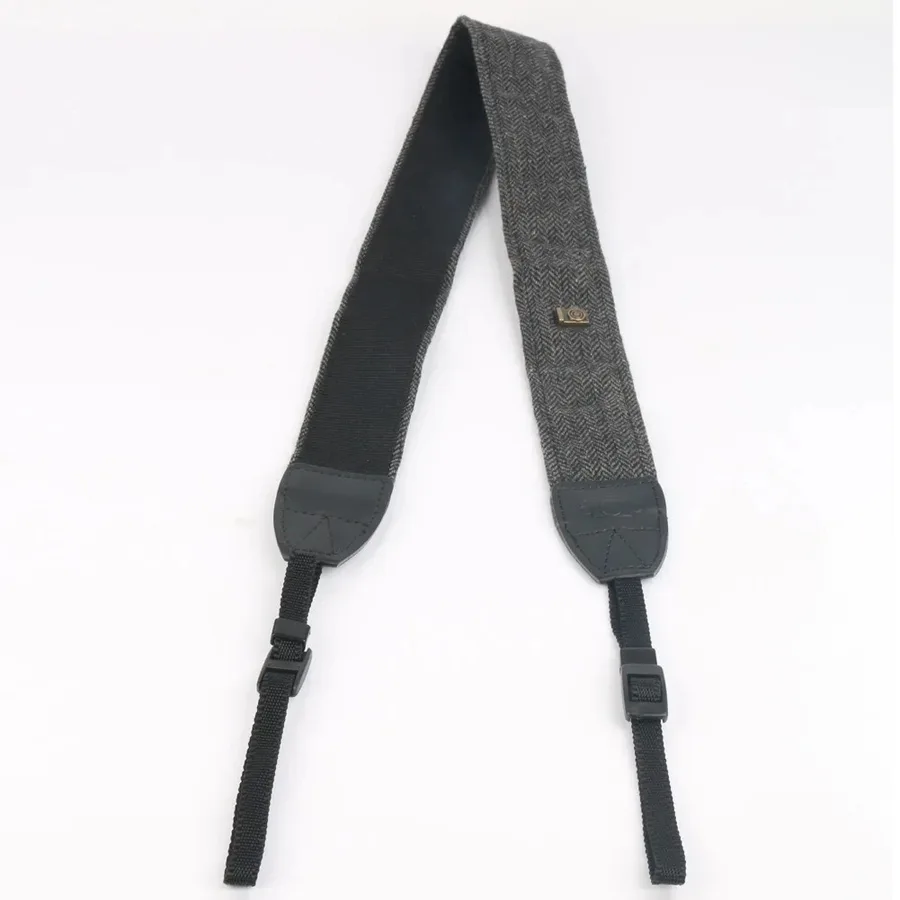
Cotton and Leather: Charcoal or Camel
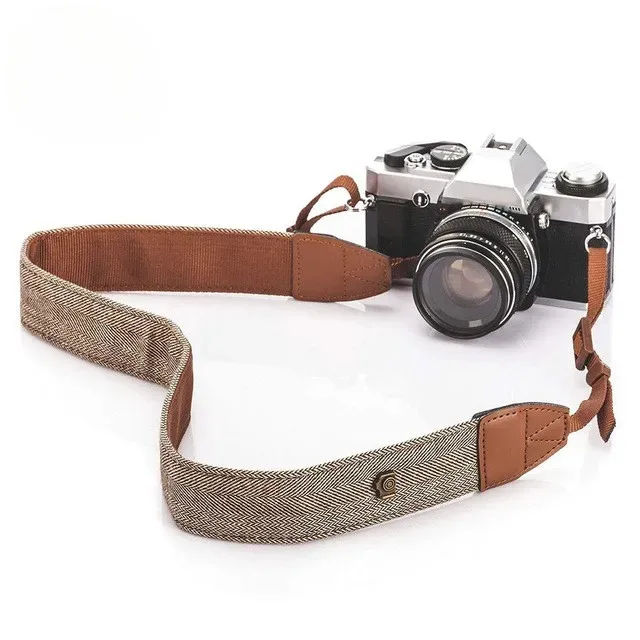
Two models, and they are genuinely different objects. Charcoal is a dark gray herringbone with black leather, which disappears against a black body and reads as deliberate rather than decorative. Camel is a warm beige tweed with tan leather, which is the one people buy for a silver film camera and then photograph on a table.
The band is wide and flat, so the weight of the body lands on a broad strip of your neck instead of a cord. The leather end pieces are stitched and finished with a small press stud, and the attachment cords thread through the camera eyelets and lock under a flat tab. It is the format that has been on cameras since the sixties, done in cotton rather than in synthetic webbing.
If this is the range you want, the leather camera strap page goes deeper on the materials and on how the tweed ages.
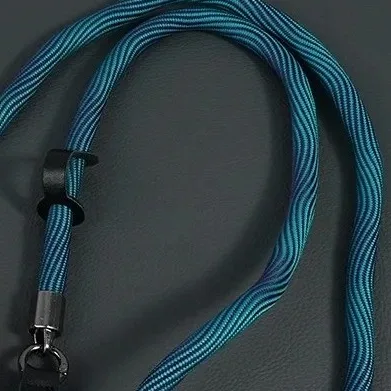
Braided Rope: eight solid colors, seven marled
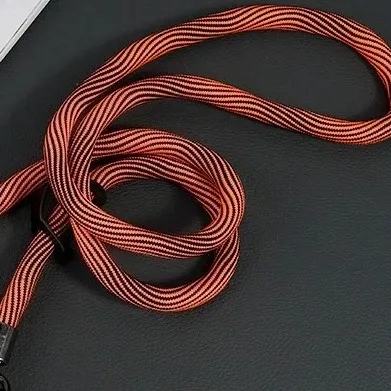
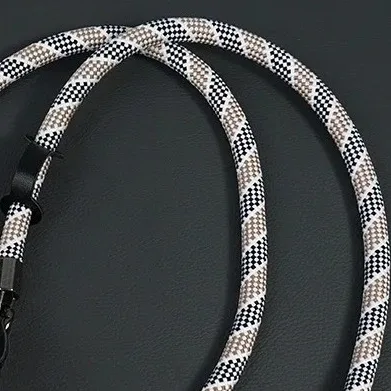
Fifteen models, split into two finishes. The solid colors are Black, Navy, Gray, Red, Olive, Sky Blue, Pink and Camel. The marled ones are braided from two tones so the cord reads as flecked rather than flat: Black Marl, Blue Marl, Teal Marl, Purple Marl, Pink Marl, Orange Marl and Mint.
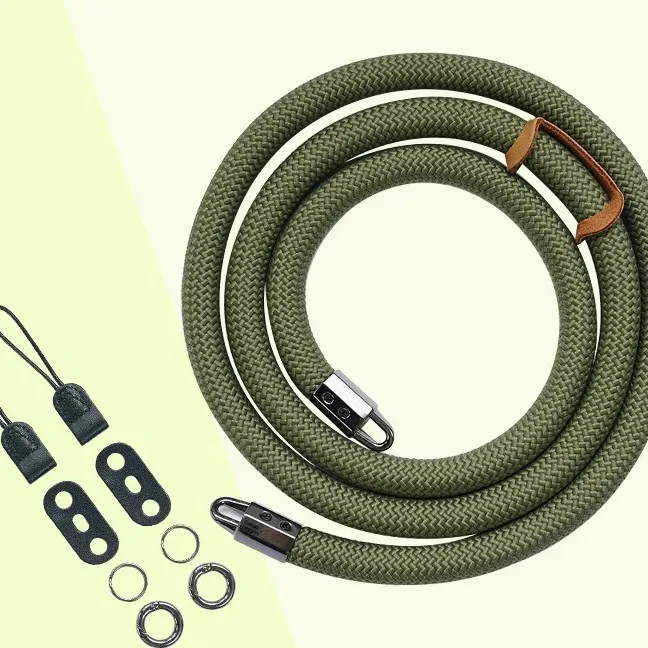
Every one of them is the same construction. Braided nylon cord, metal ends, a metal buckle head, and a ring system with a quick-release fitting so the cord comes off the body without unthreading anything. The mounting kit ships in the box: two looped cords, two flat perforated tabs and three split metal rings, which is what lets you rig it for a lug, for a split ring, or for a camera case.
The full range, and how a rope behaves differently from a flat band, is on the rope camera strap page.
Four things worth understanding before you order
None of this is complicated, but all four of these come up in the reviews, and three of them are the difference between a strap you keep and a strap that ends up in a drawer.
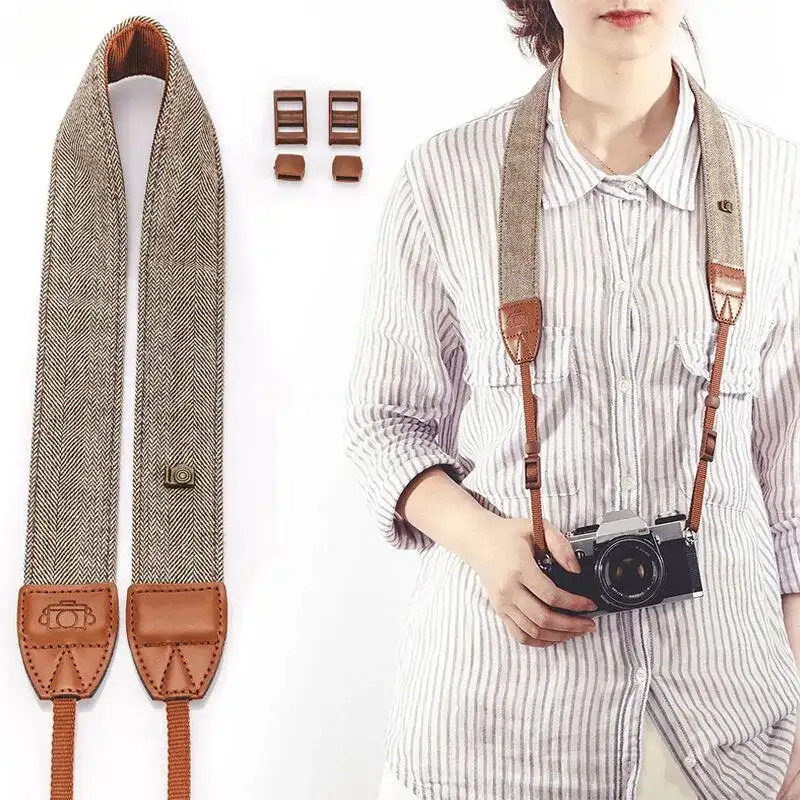
A wide band changes how long you can wear it
This is the whole argument for the cotton range, and it is why it exists alongside the rope. If you shoot a wedding, a market, a long walk in a city, you are carrying the body for six or eight hours and you feel the difference in your shoulders that evening rather than in the first hour. Fourteen of the written buyer reviews mention comfort at the neck or the shoulder without being asked about it.
Cotton also behaves differently against skin than synthetic webbing. It does not get slick when you sweat, it does not squeak against a jacket collar, and it softens with use instead of staying board-stiff. The trade is that it holds more of the day on it than nylon does, which is a laundry problem rather than a durability one.
If your main complaint is neck pressure specifically, read the camera neck strap page, which covers the drop length question in more detail.
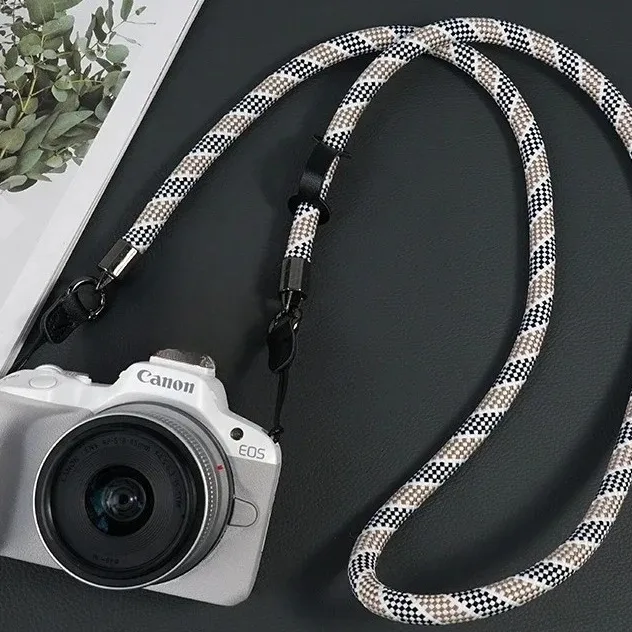
Quick release is a habit, not a feature
A strap that is annoying to remove stays on the camera permanently. It dangles into the frame on a tripod shot, it wraps itself around the lens barrel in a bag, and it is the thing you swear at when you are trying to work quickly. Photographers solve this by owning two bodies or by never using a strap at all, both of which are worse solutions than a fitting that unclips.
The metal ends are the part that matters here. Plastic clips at this size flex, then whiten, then split, usually a month after you stopped thinking about them. The specification lists metal ends and a metal buckle head on the rope range, and buyers notice: one wrote that the attachments felt like real hardware rather than cheap plastic.
The longer version of this argument, including what to check before you trust any clip with a camera body, is in our guide to quick release camera straps.
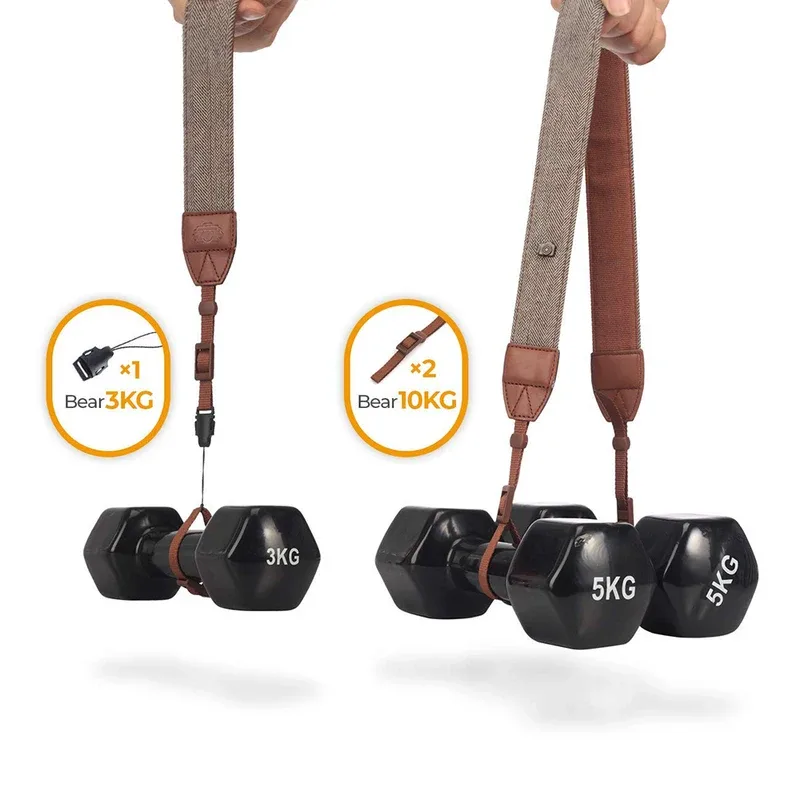
Load figures for the cotton range
The photo above shows the test: marked dumbbells hanging off the strap in two configurations, first on one attachment cord, then on both leather tabs.
Two things follow from it. First, use both leather tabs. The gap between the one-cord figure and the two-tab figure is the entire margin, and it costs you nothing to rig it properly the first time. Second, a body with a heavy telephoto lens on it is a different load than a body with a pancake, and neither range is sold as a safety device.
The braided rope range is built for small mirrorless bodies and compacts, worn cross-body.
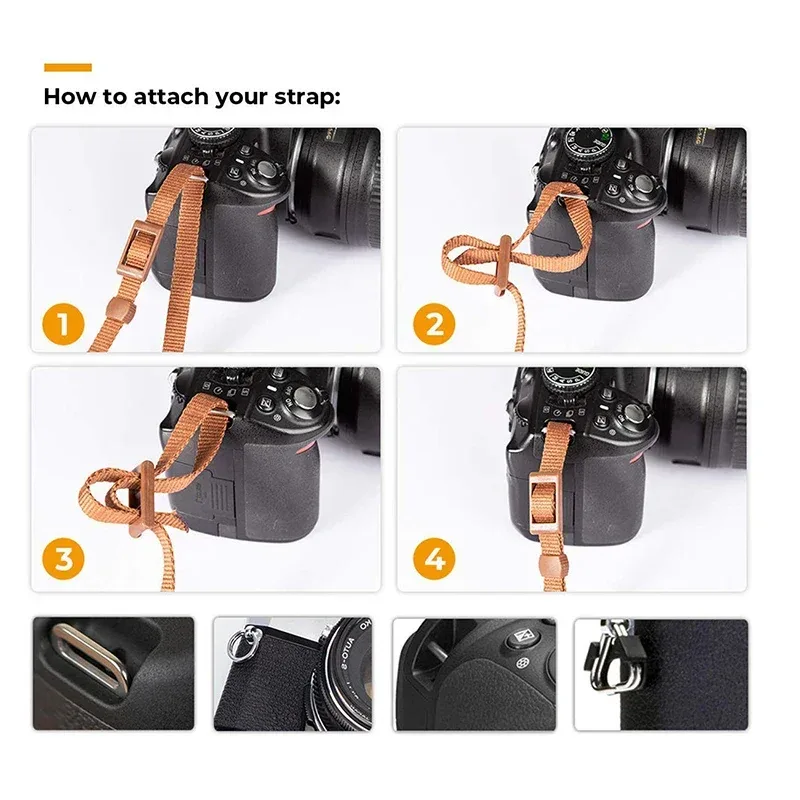
Four steps, and one of them is the one people skip
It takes about a minute per side the first time and fifteen seconds after that. The photo above shows all four steps on a real body, which is more useful than a paragraph, and the small insets show the eyelet shapes you will find on different cameras: the flat metal slot on a DSLR, the split ring already fitted on some bodies, the lug on a compact.
The mistake worth naming is stopping after step three. A cord knot pulled tight looks finished and feels finished, and it will hold for a while. The flat perforated tab exists to sit over that knot and cover it so it cannot back out. Every strap of this type ships with those tabs and a fair number of people leave them in the bag.
If your camera has an unusual lug, or you are attaching to a leather half-case rather than to the body, the full walkthrough is in how to attach a camera strap, and body-by-body notes are in our camera strap compatibility guide.
There are more cameras being carried than at any point since the pandemic
If a dedicated camera strap sounds like a niche object in a world of phone cameras, the shipment data says otherwise. Cameras with a body, a lens and two eyelets on the top corners are selling again, and every one of them needs something to hang from.
digital cameras shipped worldwide in 2025, the highest annual total since the pandemic
mirrorless cameras shipped in 2025, up from 5.6 million the year before
revenue of the photography industry in the United States
— IBISWorld, Photography in the US, 2025
The mirrorless line is the one that matters for a strap. Those bodies are smaller and lighter than the DSLRs they replaced, which is exactly why people wear them all day instead of pulling them out of a bag twice, and exactly why the strap stopped being an afterthought. A body that lives on your shoulder is a body whose strap you look at every time you use it.
"Straps do not usually break in the middle. They fail at the attachment, and almost always because somebody pulled the cord tight, thought that was the job done, and never slid the locking tab over the knot. Rig it properly once and you can forget about it for years."Ivan Petrić, Camstrand, July 2026
Everything about the strap
Buying guide: how to choose a camera strap
Start with the shape, because it decides everything else. A flat woven band presents a wide surface to your neck and shoulder and spreads the weight of the body across it. A round cord presents almost none, and puts the same weight into a narrow line. For a light mirrorless body worn for an hour, you will not care. For a heavier body worn all day, the flat band is the one you will still be wearing at six in the evening.
Then decide how the strap meets the camera. There are two families here and they are not interchangeable. Cord attachments, where a thin cord threads through the eyelet and locks under a flat tab, are the quiet ones: nothing rattles, nothing scratches the body, and nothing comes off unless you take it off. Ring and clip attachments, like the quick-release fitting on our rope range, trade a little of that permanence for the ability to remove the strap in a second. If you use a tripod regularly, or you swap between two bodies, that second is worth more than it sounds.
Third, look at what the hardware is made of. This is where cheap straps give themselves away. Plastic clips at camera scale flex under load and eventually split, usually without warning. Metal ends and a metal buckle head cost a little more to manufacture and they are the reason a strap survives being thrown in a bag for three years. Leather tabs and leather end pieces do the same job on a woven band, and they get better looking as they wear rather than worse.
Fourth, decide how you want to wear it. Around the neck is the default and it is fine for short sessions. Over one shoulder is more comfortable and less secure. Cross-body, with the strap over one shoulder and the camera at the opposite hip, is what most people settle on for a full day of walking, because the camera stays out of your arms and comes up to your eye in one movement. We cover the differences on our camera shoulder strap page, and the comparison between a neck strap, a wrist strap and a harness is in neck versus wrist versus harness. We sell neither a wrist strap nor a harness, and that article says so plainly.
Finally, be honest about color. It is the reason most people replace a strap that still works, and there is nothing wrong with that. The strap is the only part of your camera that other people see all day. Seventeen models exist on this page because the black one that came in the box is not the right answer for everybody. If you would rather read a comparison first, our best camera strap guide lays out the categories.
Specifications
| Models | 17 in total: 2 cotton and leather, 15 braided rope |
| Cotton range, band | Woven cotton tweed, chevron weave |
| Cotton range, hardware | Leather end pieces and leather tabs, press stud |
| Cotton range, colors | Charcoal, Camel |
| Cotton range, load test | 6.6 lb (3 kg) on one attachment cord, 22 lb (10 kg) on both leather tabs |
| Rope range, cord | Braided nylon, round section |
| Rope range, hardware | Metal ends and metal buckle head, ring system with quick release |
| Rope range, solid colors | Black, Navy, Gray, Red, Olive, Sky Blue, Pink, Camel |
| Rope range, marled colors | Black Marl, Blue Marl, Teal Marl, Purple Marl, Pink Marl, Orange Marl, Mint |
| Rope range, mounting kit | 2 looped cords, 2 flat perforated tabs, 3 split metal rings |
| Attachment | Standard camera eyelets, DSLR and mirrorless |
| Listed compatibility | Sony, Nikon, Canon, Fujifilm |
| Rating | 4.8 / 5 across 259 verified ratings |
We are not affiliated with any camera manufacturer.
What is in the box
What arrives depends on which range you picked, and the rope range brings more parts than most people expect.
| Cotton and Leather | The strap, with its leather end pieces, leather locking tabs and attachment cords |
| Braided Rope | The strap, plus a mounting kit: 2 looped cords, 2 flat perforated tabs, 3 split metal rings |
The mounting kit is the reason the rope range rigs onto almost anything. The looped cords go through a standard eyelet, the flat tabs lock the knot, and the split rings let you clip onto a body that already has triangular rings fitted or onto a leather half-case. Keep the spare parts: they are the difference between moving the strap to a second body in two minutes and buying a second strap.
If you pick the two-strap option, you compose two models independently, so you can put the cotton band on the camera you carry all day and a rope on the second body. Shipping is free on every order, processed in 1-2 business days and delivered in 6-10 business days, to 4 countries. The details are on our shipping page, and the 30-day money-back terms are on our refund page.
Four ways to narrow it down
Same seventeen models, sorted by the question you actually came here with.
Camera neck strap
How drop length and band width decide whether you can still wear it at the end of the day.
Leather camera strap
The cotton and leather range in detail: the tweed, the leather tabs, and how both age.
Rope camera strap
All fifteen rope models, the metal hardware, and how a round cord behaves against a flat band.
Camera shoulder strap
Shoulder, sling and cross-body carry, and which of the two ranges suits each one.
Rated 4.8 / 5 across 259 verified ratings
"The strap is beautiful and very well-made, easy to attach and very sturdy. I will soon buy more for my other cameras and to keep as a spare. I should have ordered two right away. I recommend it. It gave a new life to my analog camera and matches it perfectly."
Verified buyer
Verified buyer
"The strap seems to be quite solid and it feels high quality to the touch."
Verified buyer
Verified reviews. More buyer reviews, with photos, are on our reviews page.
Camera strap questions, answered
Which camera strap should I pick, cotton or rope?
Pick the cotton and leather band if you want a wide surface on your neck and a vintage look on a film body or a retro mirrorless. Pick the braided rope if you want the strap to come off the camera in a second, if you shoot cross-body, or if you want a color that stands out. Both cost the same and both fit the same bodies.
Will this camera strap fit my camera?
Both ranges attach through the standard eyelets found on the top corners of a camera body, so they fit DSLR and mirrorless bodies alike. They are listed as compatible with Sony, Nikon, Canon and Fujifilm cameras. If your body has triangular split rings fitted, the rope range clips straight onto them. We are not affiliated with any camera maker.
How do you attach a camera strap to a camera?
You thread the thin attachment cord up through the eyelet, pull a loop through, pass the end of the strap through that loop, then pull it tight and slide the flat locking tab down over the knot. That last step is the one people skip, and it is the one that keeps the knot from working loose. The four steps are printed in our photos and written out in our attachment guide.
How much weight can the strap hold?
The load test covers the cotton and leather range only. With a single attachment cord it held 6.6 lb (3 kg), and with both leather tabs engaged it held 22 lb (10 kg). Neither range is sold as a climbing or safety product.
Can I wear it cross-body instead of around my neck?
Yes, and most rope buyers do. The rope range is long enough to go over one shoulder and across your chest, which keeps the camera at your hip and out of the way when you walk. One buyer wrote that around the neck the camera hung lower than expected, and that cross-body it sat at a good length for quick access. The cotton band works both ways too.
Do the rope straps really come off quickly?
Yes. The rope range uses a ring system with a quick-release fitting: the cord detaches from the metal rings without unthreading anything and without a screwdriver. That matters on a tripod, in a bag, or when you hand the body to someone else. The cotton range does not do this. It is attached with cords and leather tabs, and taking it off means undoing them.
Is the strap adjustable?
The cotton and leather band is adjustable through its sliders, so you set the drop once and leave it. The rope range comes with a mounting kit of two looped cords, two flat perforated tabs and three split metal rings, which lets you change how it hangs and which fittings you use. Length is set by how you rig it rather than by a buckle in the middle.
How fast does it ship, and what if I do not like it?
Every order ships free, is processed in 1-2 business days and is delivered in 6-10 business days. Orders go to {SHIP_COUNT} countries. If the strap is not what you expected, you have a 30-day money-back guarantee: contact us within 30 days of delivery and we refund you. The terms are on our refund page.
Pick the band or pick the rope, then pick the color
Seventeen models from $24.95, with free shipping, delivery in 6-10 business days and a 30-day money-back guarantee.
🚨 Some models arrive in small batches and the current one is running low
Choose my strapThe short version
A camera strap is the only accessory you touch every single time you use the camera, and it is usually the first thing people replace. The one in the box is black nylon, it is thin, it carries the manufacturer's name in large letters, and it does the job without ever being pleasant. Replacing it is the cheapest change you can make to how a camera feels in your hands.
Camstrand sells one camera strap in seventeen models across two ranges. The Cotton and Leather range is a wide woven tweed band with leather end pieces and leather locking tabs, in Charcoal or Camel, and it is the one to pick if you want the weight spread across your neck and a look that belongs on a film body. The load test on that range held 6.6 lb (3 kg) on a single attachment cord and 22 lb (10 kg) with both leather tabs engaged.
The Braided Rope range is fifteen models of round nylon cord with metal ends, a metal buckle head and a ring system with a quick-release fitting, so the strap comes off the body without unthreading anything. Eight of them are solid colors and seven are two-tone marled. Every rope strap ships with a mounting kit of two looped cords, two flat perforated tabs and three split metal rings, which is what lets it rig onto a DSLR lug, a mirrorless eyelet, a fitted split ring or a leather half-case.
Both ranges attach through the standard eyelets on the top corners of a camera body, and they are listed as compatible with Sony, Nikon, Canon and Fujifilm bodies, DSLR and mirrorless alike. We are not affiliated with any of those manufacturers. Across the 119 written buyer reviews, build quality was the single most mentioned theme at 56 percent, appearance came second at 36 percent, and not one review complained about slow delivery.
Every order ships free, is processed in 1-2 business days, arrives in 6-10 business days and is covered by a 30-day money-back guarantee. If you want to read before you choose, start with the best camera strap guide or with how to attach a camera strap. If you already know which one you want, the selector is at the top of this page, from $24.95.